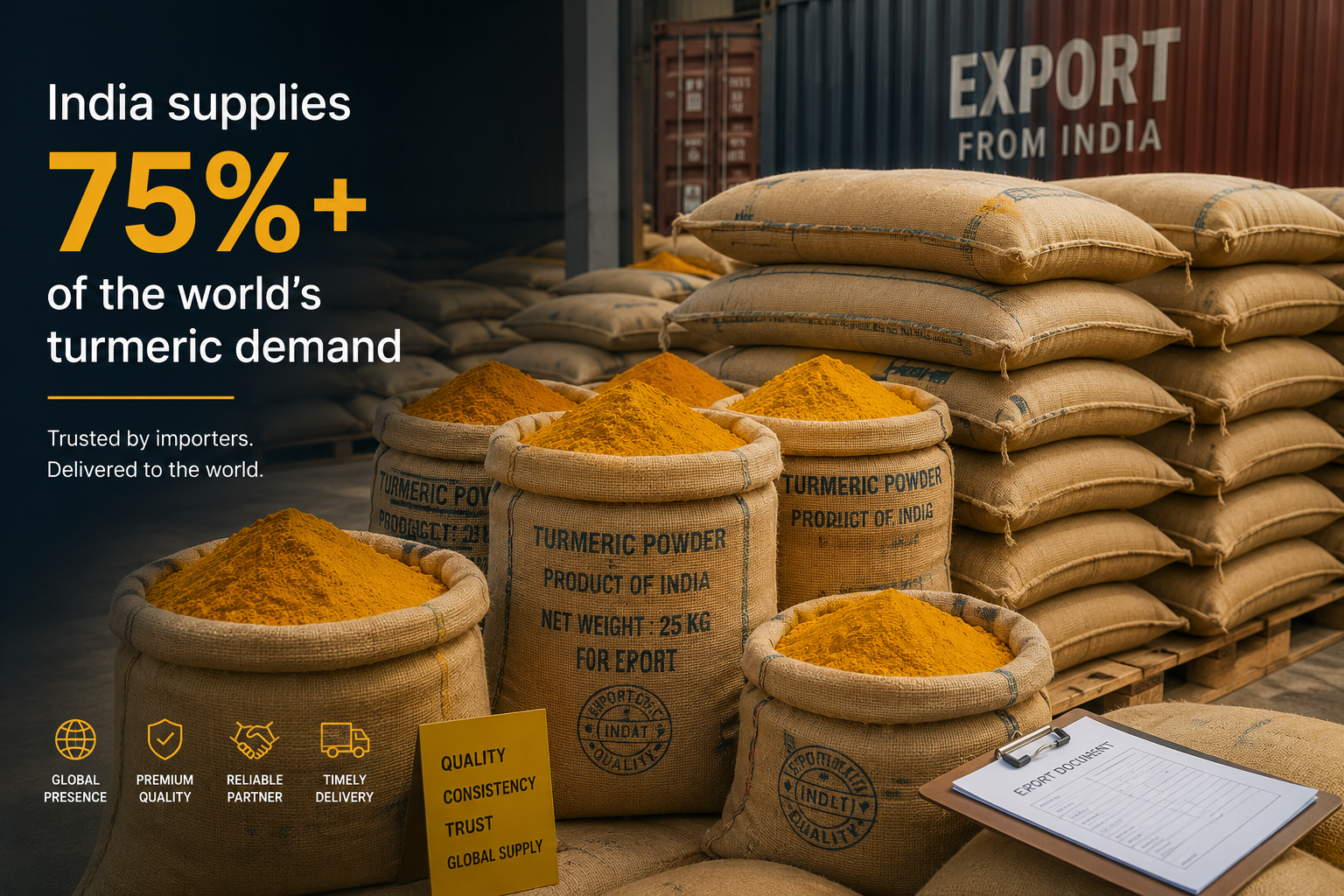
India supplies over 75% of the world's turmeric — FSSAI certified, Spice Board registered
bulk export
2026 guide: HS code, import duty by country, FSSAI & Spice Board requirements, export
documents, and how to source verified Indian turmeric
India supplies over 75% of the world's turmeric. If you are an importer, wholesaler, or food
manufacturer looking to source turmeric powder from India, understanding the export framework —
HS codes, import duties, compliance requirements, and documentation — is the difference between
a smooth first shipment and a costly customs hold.
This guide covers everything: the correct HS code for turmeric powder, country-wise import duty
rates, FSSAI and Spice Board requirements, and the exact documents your supplier should provide
before your container ships.
Before diving in, if you are new to sourcing from India, our complete guide to importing
spices from India covers the end-to-end process — from finding and vetting suppliers to
payment terms and first-shipment logistics.
Featured Snippet:
What is the HS code for turmeric powder export from India?
The HS code for turmeric powder export from India is 09103000 under India's
ITC-HS classification system. It falls under Chapter 09 (Coffee, Tea, Maté and Spices),
Heading 0910 (Turmeric/Curcuma). The first 6 digits — 091030 — are internationally
standardized under the World Customs Organization's Harmonized System and are recognized by
customs authorities in over 200 countries.
Turmeric powder export refers to the commercial trade of dried, ground turmeric (Curcuma longa)
from India to international buyers — including food manufacturers, spice distributors, health
product companies, and retail chains.
India is the dominant global supplier. According to Spice Board of India data, India exports
over 1.5 lakh metric tonnes of turmeric annually, with the USA, Bangladesh, UAE, UK, and
Malaysia among the leading destinations. The product is traded in several forms: whole finger
turmeric, sliced turmeric, and turmeric powder — each with specific buyer segments and
compliance requirements.
For exporters and importers alike, turmeric powder export means more than a price negotiation.
It involves HS code classification, phytosanitary clearances, pesticide residue compliance, and
country-specific import duties — all of which determine whether your shipment clears customs or
gets detained at port.
2. Turmeric powder HS code in India
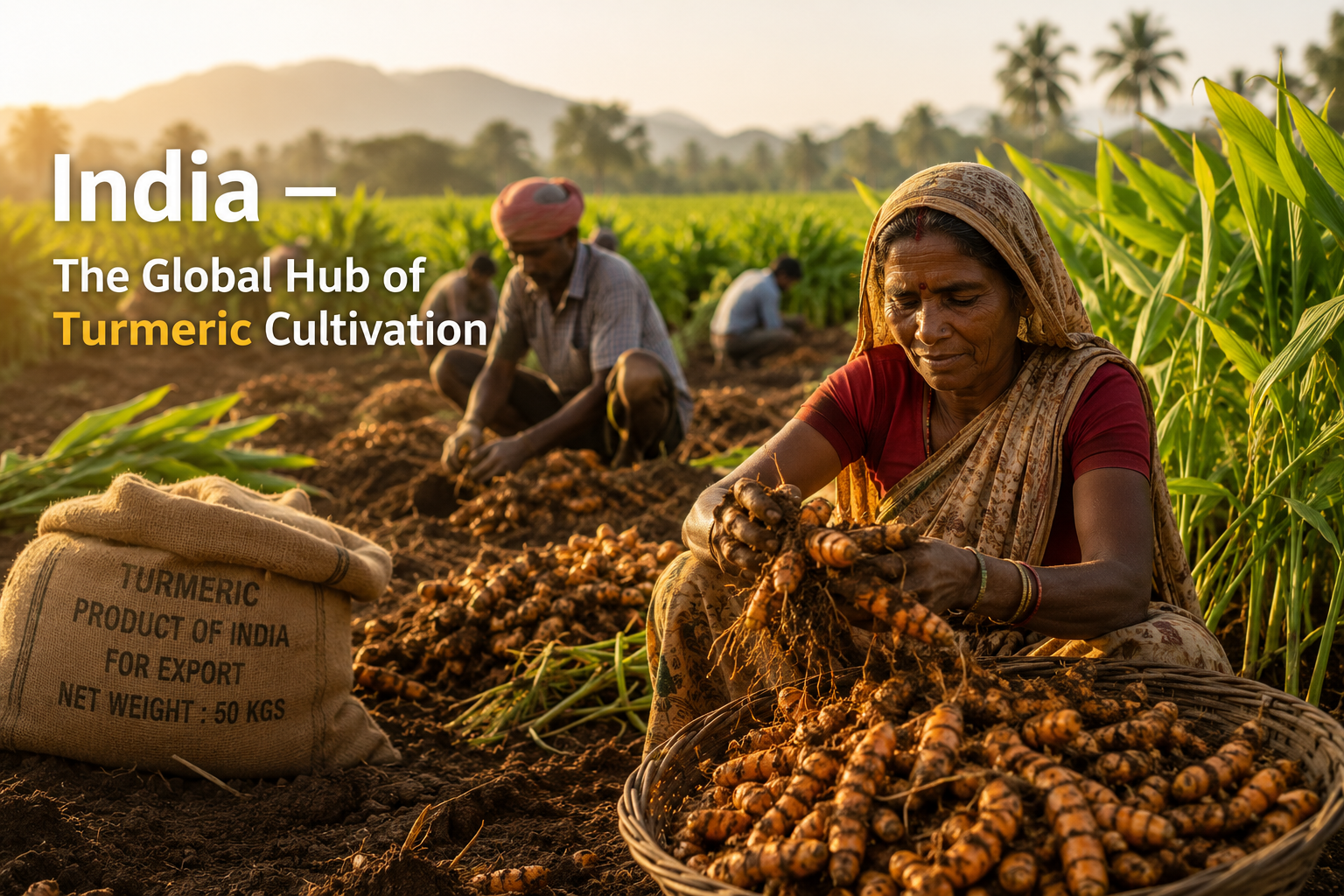
Turmeric (Curcuma longa) harvested and processed for bulk powder export from India
The HS code for turmeric powder in India is
09103000. Here is how the classification breaks down:
Level
Code
Description
Chapter
09
Coffee, Tea, Maté and Spices
Heading
0910
Ginger, Saffron, Turmeric (Curcuma), Thyme, Bay Leaves, Curry
and Other Spices
Sub-heading
0910 30
Turmeric (Curcuma)
ITC-HS (8-digit)
09103000
Turmeric (Curcuma) — all forms including powder
The same 8-digit code covers both whole dried turmeric and turmeric powder in India's ITC-HS
system. The differentiation is made at the product description level in the shipping bill.
Some importing countries use a 10-digit national tariff code — for example, the US uses the HTS
system where turmeric is classified under 0910.30.0000. Always confirm the exact
destination-country code with your customs broker before shipment.
3. How HS codes work in exports
The Harmonized System (HS) is an internationally standardized product classification system
developed by the World Customs Organization (WCO), used by over 200 countries. Here is how it
works in practice for a turmeric powder shipment:
The first 6 digits are universal. Every WCO member country uses 091030 to
refer to turmeric. This is the internationally agreed sub-heading.
Digits 7–8 are country-specific. India adds two digits to create 09103000
in its ITC-HS system. The importing country may extend this further to 10 digits.
The HS code goes on the shipping bill. When the Indian exporter files the
shipping bill at customs via ICEGATE, the code must exactly match the product. A wrong code
triggers reclassification, duty disputes, or seizure.
Import duty is determined by the HS code. The importing country's customs
authority looks up the heading and applies the applicable tariff — which varies
significantly by country and trade agreement.
Certificate requirements are code-linked. Phytosanitary certificates, lab
tests, and permit requirements for HS 0910 30 imports are triggered by the code, not just
the product name.
4. Why HS code matters in international trade
Getting the HS code wrong is one of the most expensive
mistakes in export trade. Here is why precision matters:
Duty calculation: The wrong code can result in your buyer paying
significantly higher import duty — or trigger an anti-dumping tariff that applies to a
different sub-category.
Customs clearance: Misclassification causes holds, inspections, and delays.
In time-sensitive shipments, a two-week port hold can compromise the product.
Export incentives: In India, certain HS codes are eligible for RoDTEP
(Remission of Duties and Taxes on Exported Products) benefits. The correct code ensures your
exporter claims the right benefit — and that your pricing reflects it.
Trade agreements: Bilateral agreements such as India–UAE CEPA offer
preferential duty rates tied to specific HS codes. Your buyer may qualify for a lower duty
if the HS code and Certificate of Origin are correctly aligned.
Documentation consistency: Your commercial invoice, packing list, Bill of
Lading, and Certificate of Origin must all carry the same HS code. Any mismatch is a customs
red flag.
5. Import duty on turmeric powder by country
Turmeric powder departing Indian ports — duty rates vary significantly by destination
country
Import duty rates vary by destination country,
applicable trade agreements, and product type (conventional vs organic). The table below covers
the major import markets for Indian turmeric powder.
Country
Standard Import Duty
Key Notes
USA
0%
Duty-free under US HTS 0910.30.0000
UAE
5%
Standard GCC tariff; may reduce under India–UAE CEPA
UK
0%
Zero under UK Global Tariff for HS 0910 30 00
Germany / EU
0%
EU Common External Tariff: 0% for dried spices
Australia
0%
Duty-free under standard tariff
Japan
3.2%
Standard rate; may reduce under India–Japan CEPA
Canada
0%
Duty-free under HS 0910
Bangladesh
25%
Higher tariff; large volume market regardless
Sri Lanka
15%
Standard import tariff
Saudi Arabia
5%
GCC standard tariff
These rates are indicative and subject to change. Always confirm with a licensed customs broker
in the destination country. Rates may differ for organic-certified turmeric or turmeric with
additives, which can reclassify under a different HS heading.
For US-bound shipments specifically, our turmeric powder export to USA
guide covers FDA prior notice, heavy metal compliance, US port logistics, and labelling
in detail.
GST and VAT on import are separate from customs duty. UK importers, for example, pay 0% customs
duty but are charged import VAT at 20%, which is reclaimed if the importer is VAT-registered.
6. Export regulations from India
India's turmeric powder exports are governed by two primary authorities: the Food Safety and
Standards Authority of India (FSSAI) and the Spice Board of India, under the Ministry of
Commerce and Industry.
Key regulatory requirements for Indian turmeric
exporters:
Spice Board of India registration — Mandatory for all turmeric exporters.
Certification confirms the exporter meets quality standards set by the Board. Registration
must be renewed annually.
FSSAI export compliance — Turmeric powder for export must comply with FSSAI
standards covering moisture content, ash content, and — critically — pesticide residue
levels (MRLs). For a full breakdown, see our guide to FSSAI and Spice Board
requirements for Indian spice exports.
Phytosanitary Certificate — Issued by the Plant Quarantine authority, this
confirms the product is free from pests and diseases. Required by most importing countries
as a condition of entry.
RoDTEP scheme — Exporters can claim benefits under the Remission of Duties
and Taxes on Exported Products scheme. The rate applicable to HS 09103000 is periodically
revised — confirm the current rate with a trade consultant before finalizing your export
pricing.
APEDA registration (organic exports) — Exporters of organic turmeric must
be registered with APEDA and hold NPOP (National Programme for Organic Production) or NOP
certification from an accredited body.
7. Required export documents
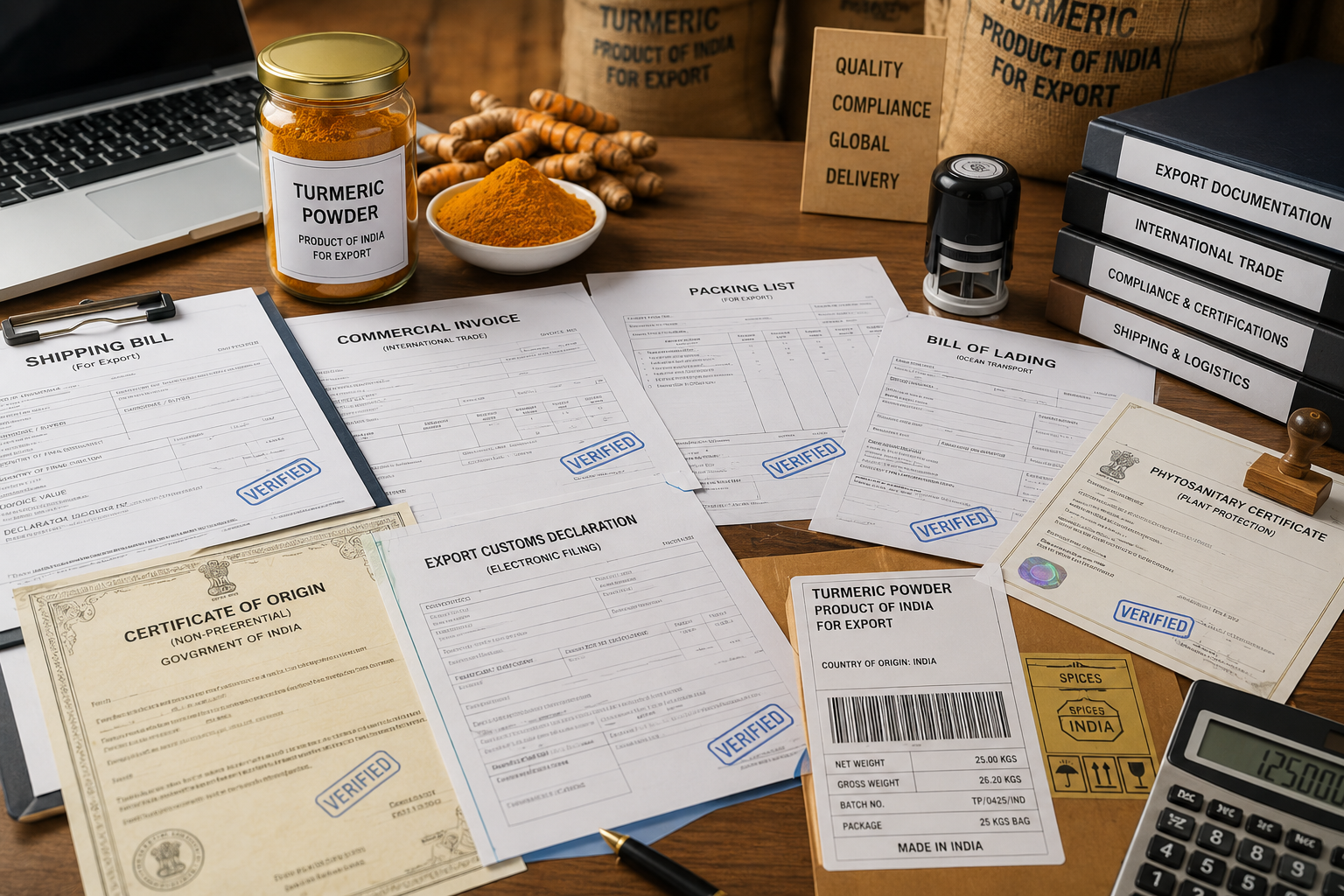
A complete turmeric export file — professional exporters provide all documents before
the container departs
A complete turmeric powder export shipment from
India requires the following documents. A professional exporter will provide all of these —
proactively, before the shipment departs.
Important for importers: Always request the lab COA before the shipment
departs India. Ask specifically that it be tested against the MRL standards of your
destination country — not only against Indian FSSAI limits.
8. FSSAI & Spice Board requirements
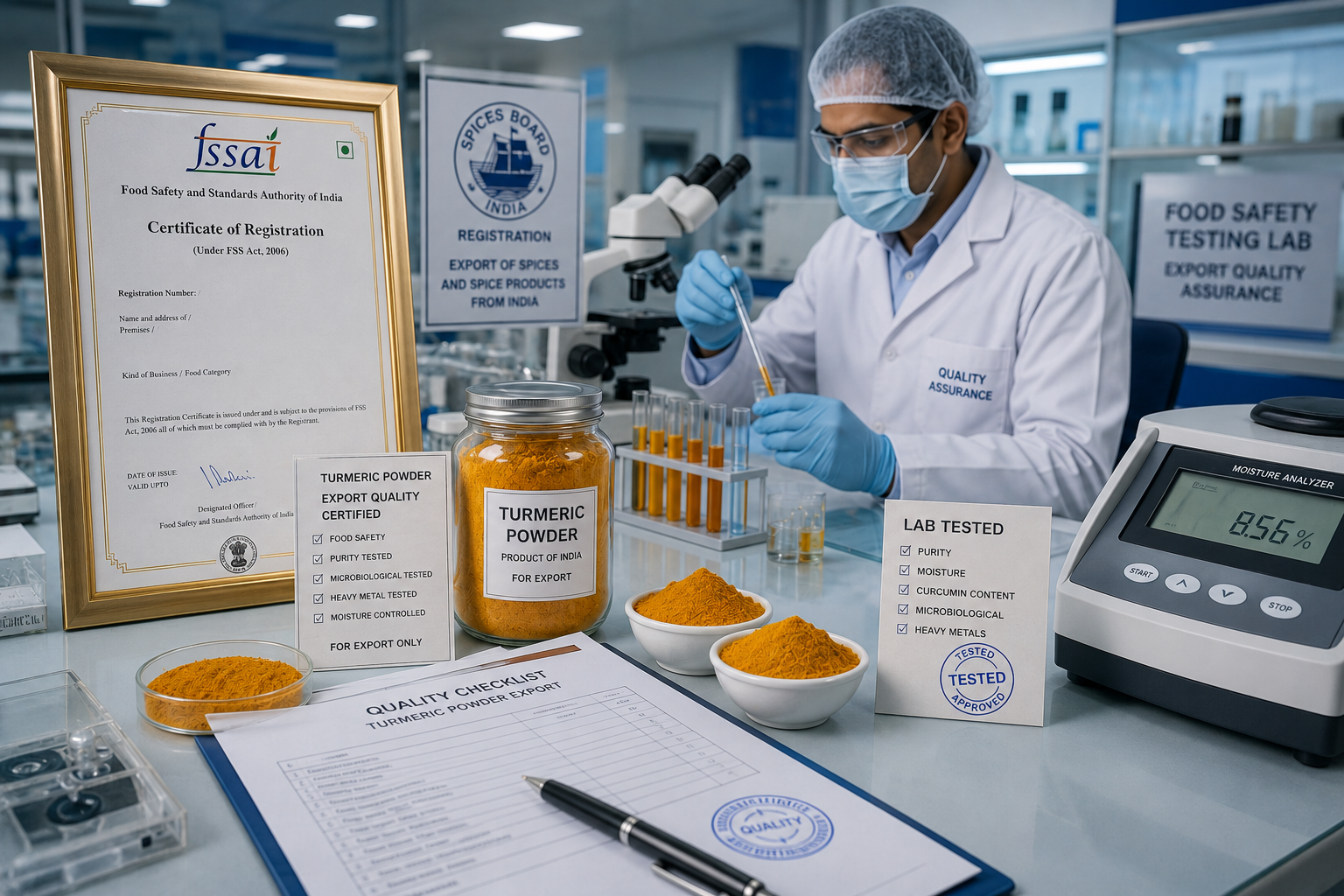
FSSAI certification is mandatory — quality standards for turmeric powder export grade
FSSAI quality standards for turmeric powder
(export grade):
Parameter
Standard
Moisture
Maximum 10%
Total ash
Maximum 9% (dry basis)
Acid-insoluble ash
Maximum 1.5%
Curcumin content
Minimum 2% (export quality)
Extraneous matter
Maximum 0.5%
Pesticide residues
Must comply with destination country MRLs
Spice Board of India — exporter registration
requirements:
Valid IEC (Import Export Code) from DGFT
Spice Board registration certificate
Compliance with Spice Board quality norms for turmeric
Annual renewal of registration
Country-specific MRL compliance is the most common cause of shipment rejection at ports
worldwide. The EU, USA, Japan, and Australia each maintain their own Maximum Residue Level
tables for pesticides — and these are often stricter than Indian FSSAI limits. Always
request a COA tested against the importing country's MRL list, not just the Indian standard.
For detailed guidance on verifying supplier certifications, our guide to FSSAI and Spice Board
registration for exporters explains exactly what each document should contain and
how to spot a fraudulent certificate.
9. Packaging & labelling rules
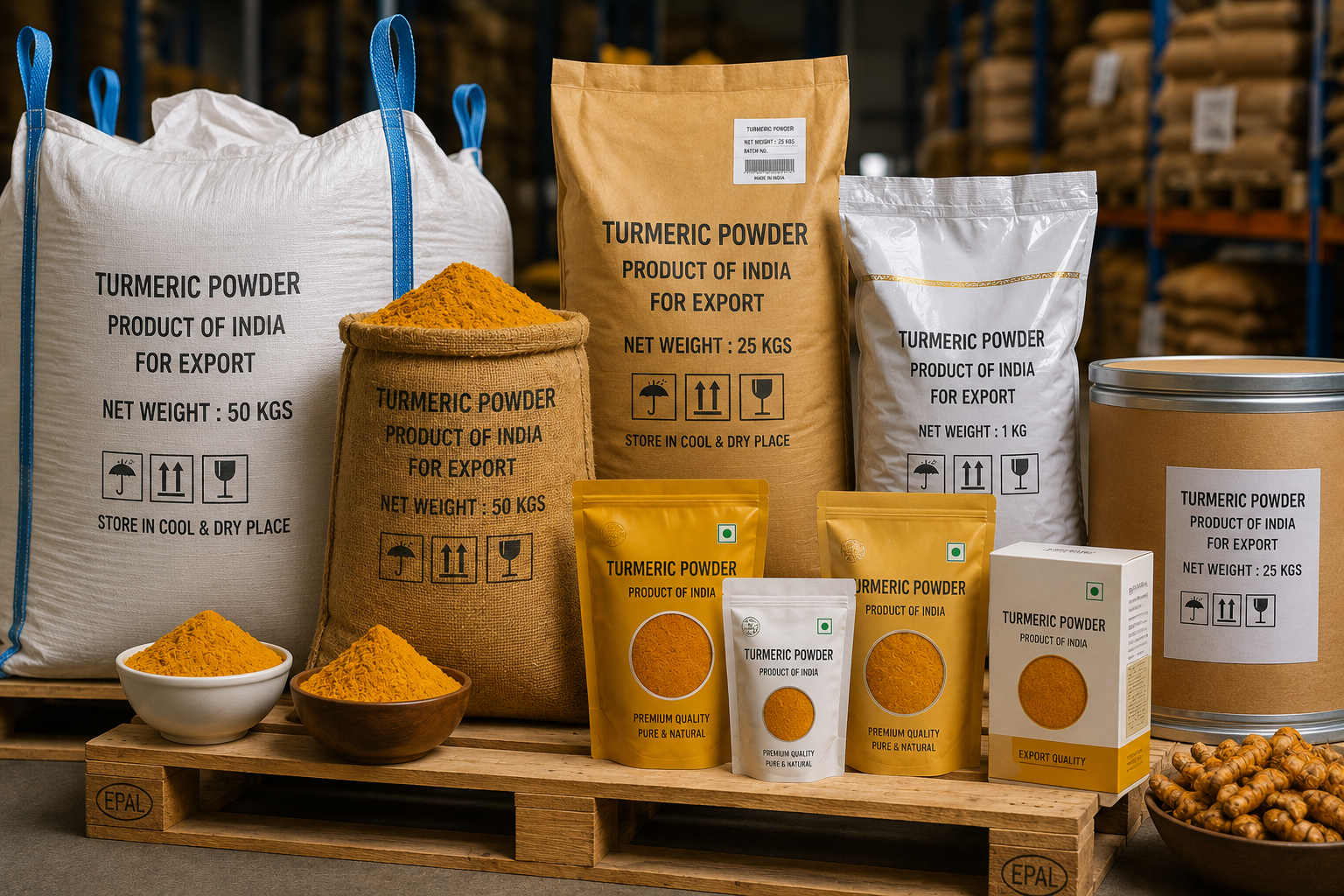
Food-grade HDPE bags with moisture-proof lining — standard packaging for turmeric powder
bulk export
Packaging standards for turmeric powder export:
Food-grade HDPE or PP woven bags (25 kg, 50 kg standard) for bulk export
Multi-layer kraft paper bags or stand-up pouches for retail or food service packs
Moisture-proof inner lining is mandatory — moisture absorbed during 25–35 day sea
transit causes clumping and quality degradation
Palletisation and stretch-wrapping for container loading stability
General export labelling requirements — every
export pack must carry:
Product name: Turmeric Powder (Curcuma longa)
Country of origin: India
Net weight
Lot/batch number
Manufacturing date and best-before date
Exporter name, address, and IEC number
HS code (on all commercial documents)
Destination-specific labelling rules:
USA: FDA-compliant label; Nutrition Facts panel required for
retail-packed product
EU/Germany: EU food labelling regulation compliance; allergen
declarations required
UAE: Arabic language mandatory on retail packaging
Organic exports: Must carry certification body logo and certificate
number on packaging
10. Common mistakes exporters make
Wrong HS code on the shipping bill — Using 09103000 for a value-added
turmeric product — such as turmeric with curcumin extract added — can trigger
reclassification under a different heading, potentially with a higher duty rate and
different documentation requirements at destination.
Not testing against the destination country's MRL — Testing only
against Indian FSSAI limits and then shipping to the EU or Japan is a frequent cause of
port rejection. EU MRL limits for certain pesticides are significantly stricter than
Indian limits.
Inconsistent documentation — The HS code, product description, and
weight must match exactly across the shipping bill, commercial invoice, packing list,
and Certificate of Origin. Even a minor variation — "turmeric" vs "turmeric powder" —
can generate a customs query.
No pre-shipment quality inspection — Skipping a third-party
pre-shipment inspection to reduce cost, then facing buyer rejection on arrival, costs
far more in return logistics, re-export fees, or destruction charges.
Misunderstanding Incoterms — FOB means the importer handles freight and
insurance from the Indian port. CIF means the exporter includes it in the price. Our FOB vs CIF guide for
spice exports explains these terms in detail with worked examples.
Moisture content at stuffing — Sea transit from India to Europe or
North America takes 25–40 days. Turmeric powder that exceeds moisture limits at the time
of container stuffing will clump, discolour, or develop off-odours on arrival. Always
test moisture content immediately before stuffing.
11. How to find turmeric powder buyers
B2B trade platforms
Alibaba.com — the largest global B2B marketplace; optimize product listings with HS
code, certifications, and full quality specifications
IndiaMART — strong for Middle East, Southeast Asia, and South Asian buyers
TradeIndia — useful secondary platform for India-origin searches
Global Sources — preferred by certain Southeast Asian buyers and large importers
Trade shows
World Spice Congress (organized by Spice Board India)
Anuga and SIAL (Europe) — premium food ingredient buyers
Gulfood (UAE) — strong for GCC and Middle East markets
Fancy Food Show (USA) — specialty and natural food importers
Direct outreach
LinkedIn: target food procurement managers, spice category buyers, and private-label
sourcing heads in target markets
Content-led inbound: Ranking for keywords like "turmeric powder exporter India"
generates consistent inbound inquiries from buyers actively researching suppliers —
buyers researching HS codes and compliance are typically in active procurement mode.
12. Pricing factors in turmeric export
Factor
Impact on price
Raw turmeric market price
Primary driver; Erode (Tamil Nadu) spot market is the
benchmark
Curcumin content (%)
Higher curcumin = premium; typical export range is 2–5%
Crop season
Post-harvest (Jan–Mar) typically lower; pre-harvest
(Oct–Dec) higher
Certification
Organic-certified commands 30–60% premium over
conventional
Grade
Powder from high-grade finger turmeric commands premium
over mixed-grade
Packaging
Retail-ready packaging adds cost vs bulk HDPE bags
Incoterm
FOB India vs DDP destination varies significantly in
landed cost
Market prices move with the agricultural cycle.
Always request a fresh quote — pricing from three months ago may not reflect current market
conditions.
13. Shipping & logistics considerations
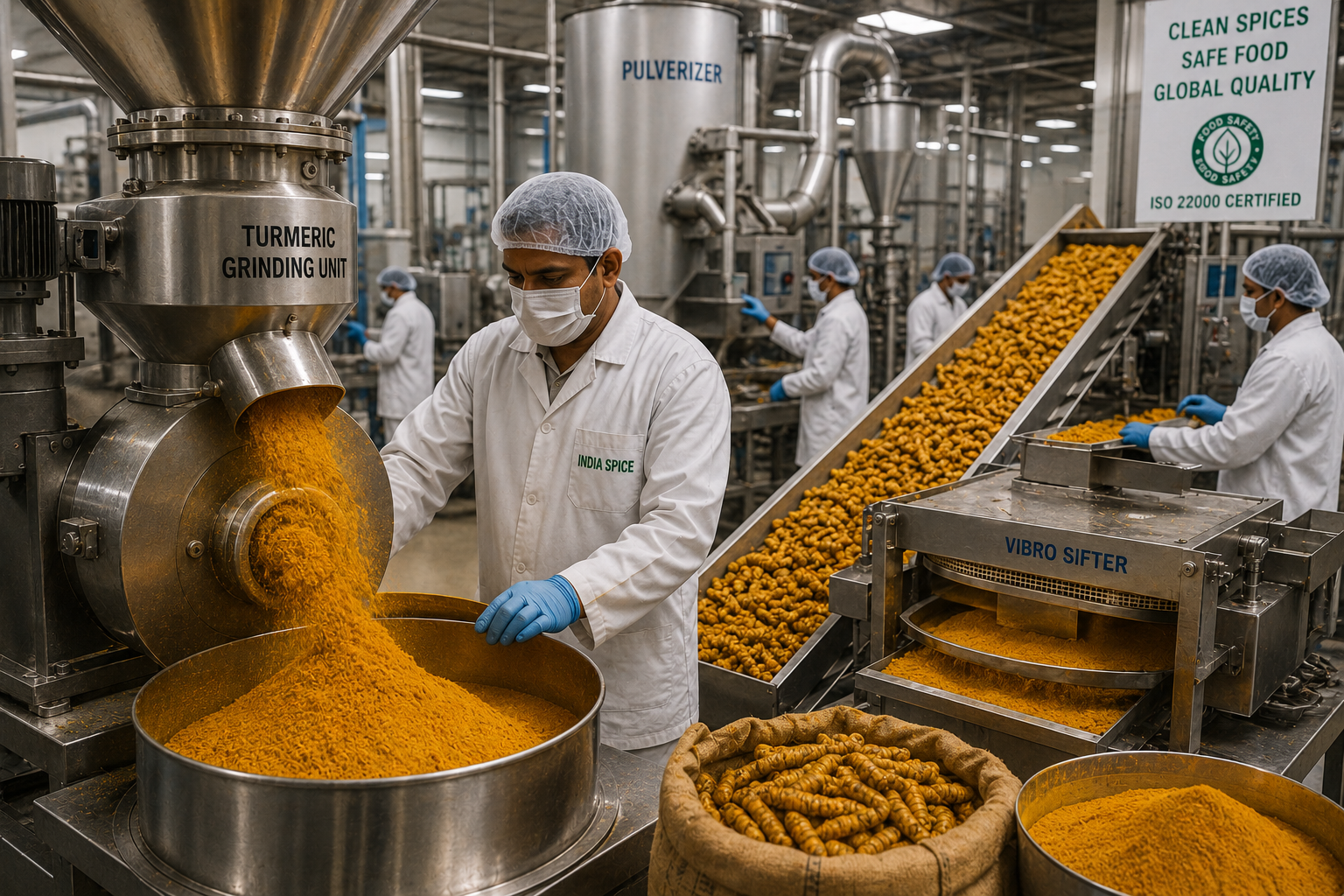
Turmeric processing and grinding plant — bulk powder prepared for sea freight export
from India
Sea freight is the standard mode for bulk turmeric
powder export from India. Air freight is used only for samples or urgent small parcels where
cost-per-kg is not the primary concern.
Key Indian ports for turmeric powder
export
Port
Strengths
Nhava Sheva (JNPT), Mumbai
Largest container port; preferred for US and Europe routes
Chennai Port
Strong for Southeast Asia, Australia, East Africa
Mundra Port (Gujarat)
Growing capacity; good road connectivity to Ahmedabad and
Rajkot production clusters
Kochi Port
Closest to Kerala and Tamil Nadu spice production zones
Approximate sea transit times
Destination
Transit time
UAE / GCC
10–14 days
UK / Europe
25–35 days
USA (East Coast)
28–35 days
USA (West Coast)
18–22 days
Australia
18–25 days
Japan
18–22 days
Cargo insurance: Strongly
recommended for all turmeric powder shipments. Marine cargo insurance covers loss, damage,
and contamination during sea transit. Importers on CIF or DDP terms receive cover from the
exporter; FOB buyers must arrange their own policy.
Fumigation: Some destination
countries require container fumigation certificates. Confirm with your customs broker in the
destination country whether a fumigation certificate is required for HS 0910 30 imports
before the container is sealed.
14. Key takeaways
The HS code for turmeric powder export from India is 09103000 — this
must appear consistently across the shipping bill, commercial invoice, packing list, and
Certificate of Origin
Most major markets (USA, EU, UK, Australia) impose zero import duty on
turmeric powder; UAE, Japan, Bangladesh, and Sri Lanka apply tariffs ranging from 3.2%
to 25%
Exporters must hold Spice Board of India registration and provide FSSAI-compliant
products with a third-party lab COA on every shipment
The most common cause of port rejection is pesticide MRL non-compliance
— always request a COA tested against the destination country's MRL standards
A complete export shipment requires 10+ documents — a professional exporter provides all
of them before the container departs India
Price is driven by curcumin content, organic certification, crop season, and order
volume — not just the daily spot price
Sea freight from India takes 10–35 days depending on destination port
15. FAQs
Q1: What is the HS code for
turmeric powder in India?
The HS code for turmeric powder export from
India is 09103000 under the ITC-HS classification. The first 6
digits (091030) are internationally standardized under the WCO Harmonized System and
are recognized in customs systems worldwide.
Q2: Is there any export duty on
turmeric powder from India?
No. India currently levies zero export duty on
turmeric powder (HS 09103000). Exporters may also be eligible to claim RoDTEP scheme
benefits on qualifying shipments.
Q3: What certifications should I
ask my Indian turmeric supplier for?
At minimum: Spice Board of India registration
certificate, FSSAI certificate, Phytosanitary Certificate, and a Certificate of
Analysis (COA) from an accredited laboratory. For organic turmeric: NPOP or NOP
certification from an APEDA-accredited body.
Q4: How do I verify that my
supplier's turmeric meets EU MRL standards?
Request a pre-shipment COA tested by an
internationally recognized laboratory — SGS, Bureau Veritas, or Intertek — against
the EU MRL database for turmeric (HS 0910). Do not accept a COA tested only against
Indian FSSAI limits. The two standards are different, and the EU standard is
typically stricter.
Q5: What is the minimum order
quantity for turmeric powder export?
Most professional exporters work with trial
order MOQs of 500 kg to 1 MT. Full container loads (FCL) are typically 18–20 MT. At
Kexor Global, we accommodate trial orders to allow buyers to evaluate quality before
committing to larger volumes.
Q6: How long does turmeric powder
take to ship from India to Europe?
Sea freight from Indian ports (JNPT or Mundra)
to major European ports such as Felixstowe, Rotterdam, or Hamburg takes
approximately 25–35 days. Allow an additional 2–5 working days for customs clearance
at the destination port.
Q7: Can I get private-label
turmeric powder from Indian exporters?
Yes. Many Indian exporters including Kexor
Global offer private-label services — custom packaging, branded labelling, and
tailored product specifications (curcumin percentage, grind size, moisture level).
Contact our team
to discuss private-label options and MOQ.
16. Conclusion
Turmeric powder export from India operates within a clear framework — HS code 09103000, zero
or low import duty in most major markets, and a defined set of documents and certifications
that every serious exporter should provide as standard.
For importers, the key to a smooth first shipment is choosing a supplier who understands
compliance — not simply one who offers the lowest price. The COA, the Spice Board
registration, the phytosanitary certificate, and MRL testing against your market's specific
standards are not optional extras. They are what separates a cleared shipment from a
detained one.
If you are still evaluating whether to source from India, our complete guide to importing
spices from India covers the full picture — supplier vetting, payment terms,
logistics, and first-shipment checklist.
Ready to source certified
turmeric powder from India?
Kexor Global is an FSSAI-certified, Spice Board-registered exporter of turmeric powder,
garlic powder, dehydrated vegetables, and eco-friendly bagasse packaging — supplying
buyers in the USA, UAE, UK, Germany, Australia, and beyond.
What we offer:
Conventional and organic turmeric powder (NPOP / NOP certified)
Full export documentation provided as standard on every shipment
COA from accredited third-party lab — tested against your market's MRL standards
Complete guide on sourcing premium Indian spices from farm to global buyers. Learn about
quality standards, export processes, and the Indian spice supply chain.
Learn how to select the right Indian exporter for snacks and savouries. Focus on quality
standards, certifications, shelf life, and export experience for successful sourcing.
Explore best practices for creating sustainable and ethical supply chains when sourcing
from India. Focus on environmental responsibility and social impact.