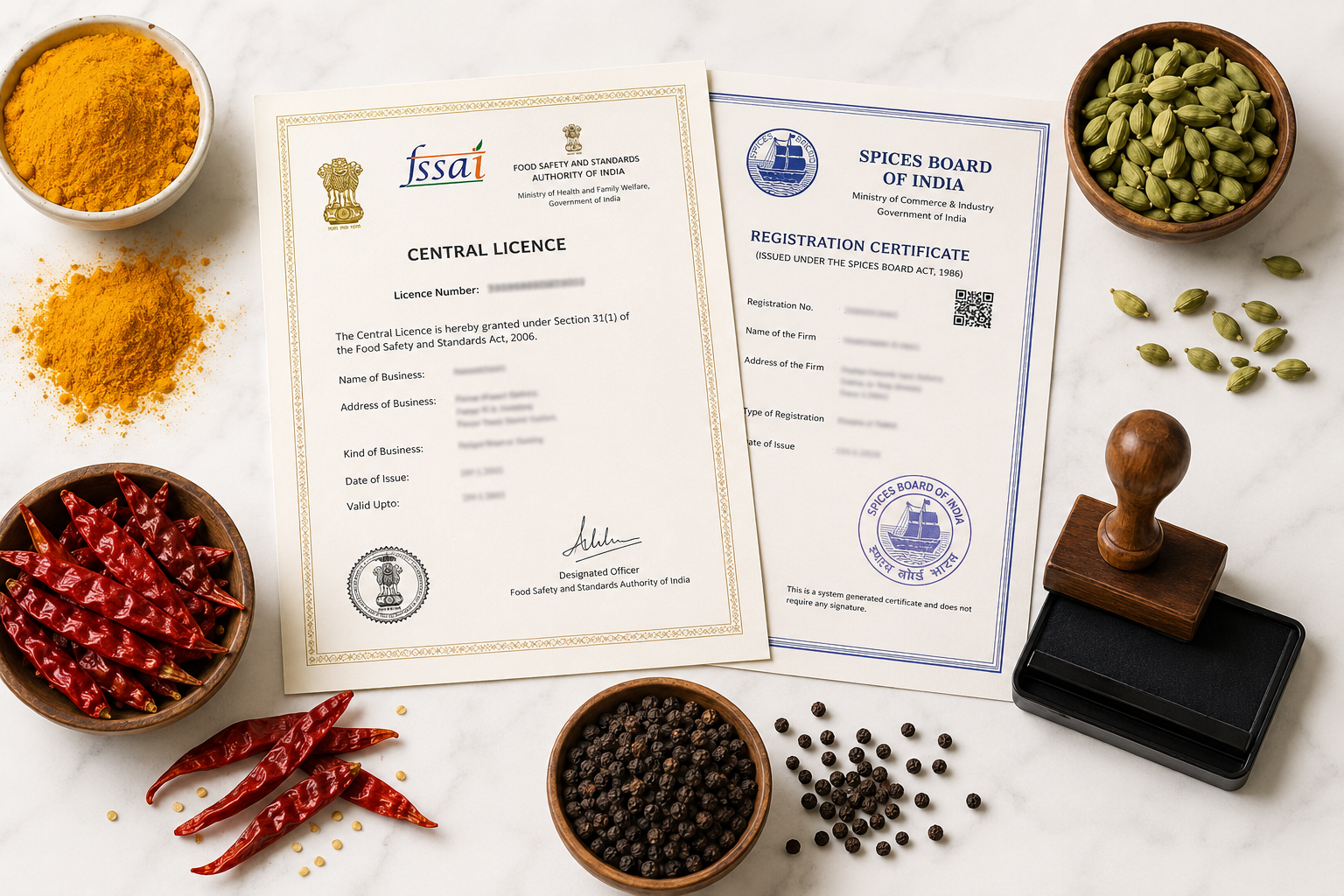
Before a single kilogram of turmeric, garlic powder, or red chilli leaves India as an export shipment, two registrations must be in place.
The first is the FSSAI Central Licence — issued by the Food Safety and Standards Authority of India, confirming the exporter operates a compliant food business. The second is the Spice Board of India registration — the statutory credential that authorizes an entity to export spices from India commercially.
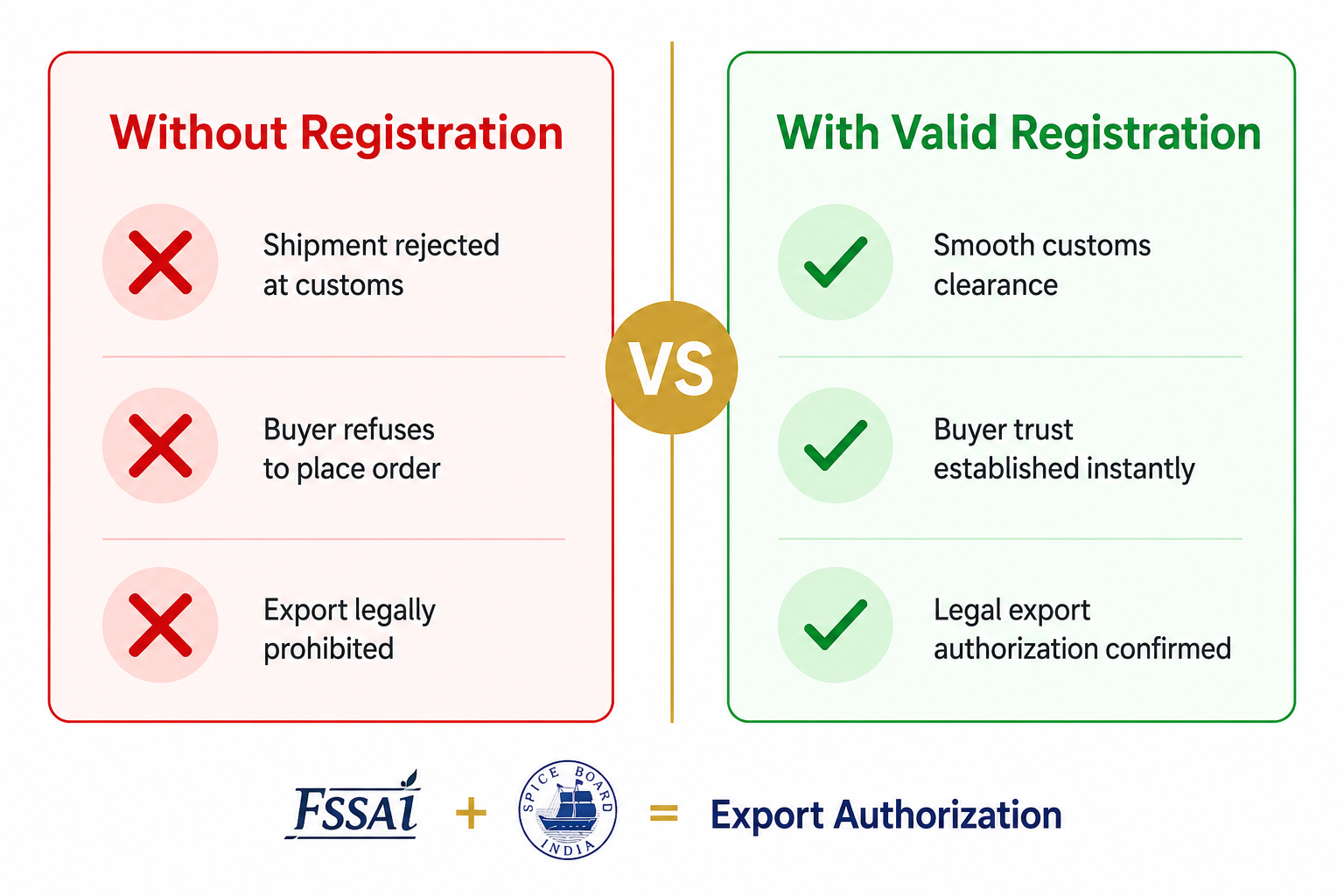
Together, these two registrations are the foundation of every legitimate Indian spice export operation. Without them, no reputable international buyer will place an order, no customs authority will process the shipment cleanly, and no bank will process an export-related Letter of Credit without question.
Yet despite their importance, many new exporters — and many importers evaluating Indian suppliers — do not fully understand what these registrations mean, what they require, how to obtain them, and critically, how to verify that a supplier's credentials are genuine. This guide covers all of it, step by step.
If you are an importer evaluating an Indian spice supplier, our complete guide to importing spices from India covers the full supplier vetting process — of which registration verification is one critical component.
Already know what you need?
View Kexor Global's certified spice export products — FSSAI Central Licence, Spice Board registered, full documentation on every shipment.
WhatsApp Us for a 2-Hour ResponseFeatured Snippet: What registrations does an Indian spice exporter need?
An Indian spice exporter requires two mandatory registrations: (1) an FSSAI Central Licence from the Food Safety and Standards Authority of India, which authorizes the business to manufacture, process, or trade food products for export; and (2) a Spice Board of India registration from the Spice Board under the Ministry of Commerce, which specifically authorizes the export of spices from India. Both are mandatory, both require annual renewal, and both can be verified online through government portals before placing an order with any Indian supplier.
Quick Reference Overview
| Registration | Issued by | Mandatory for | Validity | Verifiable online |
|---|---|---|---|---|
| FSSAI Central Licence | Food Safety and Standards Authority of India | All food exporters | 1–5 years | Yes — foscos.fssai.gov.in |
| Spice Board Registration | Spice Board of India, Ministry of Commerce | All spice exporters | Annual | Yes — spiceboard.gov.in |
| IEC (Import Export Code) | DGFT, Ministry of Commerce | All exporters | Permanent (annual update) | Yes — dgft.gov.in |
| APEDA Registration | APEDA, Ministry of Commerce | Organic spice exporters | Annual | Yes — apeda.gov.in |
1. Why these registrations matter — for exporters and importers
For an Indian spice exporter, these registrations are not optional extras. They are the legal authorization to operate as a food exporter in India. Operating without them exposes the business to regulatory action, shipment seizure, and reputational damage with international buyers.
For an international importer, these registrations are the first filter in supplier evaluation. A supplier who cannot produce a valid FSSAI Central Licence number and a Spice Board registration certificate — both verifiable online in under two minutes — is a supplier whose quality claims, certifications, and pricing cannot be trusted at face value.
The export documentation chain begins here. Every downstream document — the Certificate of Analysis, the Spice Board shipment certificate, the phytosanitary certificate — is only meaningful if the underlying exporter registrations are valid. A COA from an FSSAI-licensed facility with verified Spice Board registration carries authority. The same COA from an unregistered entity is worthless.
For a full picture of how these registrations connect to the complete export document set, our spice export documentation guide covers every document required from shipping bill to organic certificate.
2. What is FSSAI — overview and mandate
The Food Safety and Standards Authority of India (FSSAI) was established under the Food Safety and Standards Act, 2006. It is the apex regulatory body for food safety in India, operating under the Ministry of Health and Family Welfare.
FSSAI's mandate covers:
- Setting standards for food products including spices, processed foods, and agricultural commodities
- Licensing and registering food businesses across India
- Enforcing compliance through inspections, audits, and laboratory testing
- Regulating import and export of food products
- Setting Maximum Residue Limits (MRLs) for pesticides in food
- Issuing guidance on food labelling, additives, and contaminants
For spice exporters, FSSAI's relevance extends beyond the licence itself. FSSAI sets the quality standards — moisture limits, ash content, MRL thresholds, microbiological limits — that determine whether a batch of turmeric powder or garlic powder meets food safety requirements. The COA on every shipment is testing against FSSAI standards as a baseline.
FSSAI's three-tier licensing system
FSSAI operates a three-tier system based on business size and type. Understanding which tier applies to your business is the first step in the registration process.
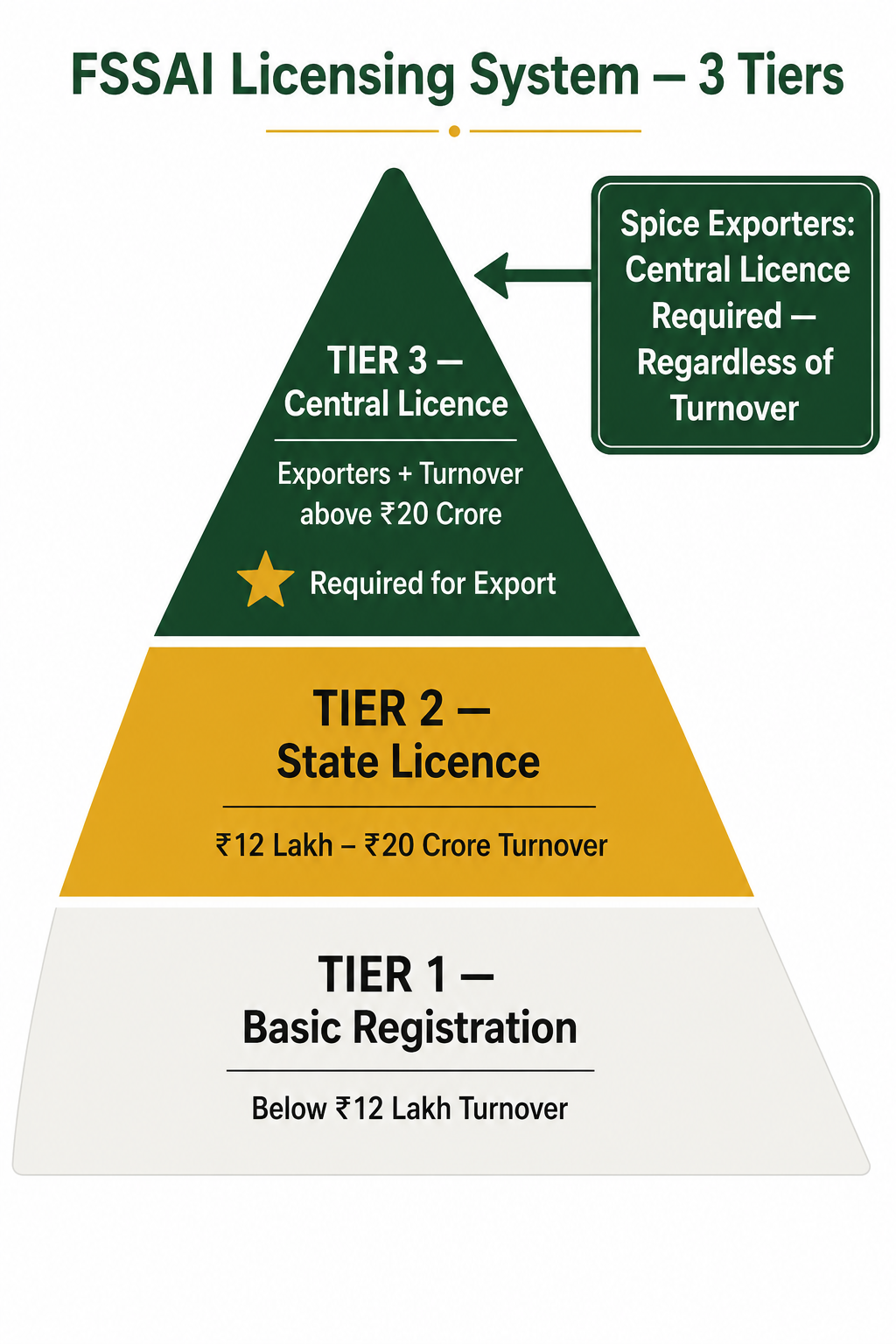
| Tier | Type | Turnover threshold | Typical for |
|---|---|---|---|
| Tier 1 | Basic Registration | Below ₹12 lakh per year | Very small food vendors, home businesses |
| Tier 2 | State Licence | ₹12 lakh – ₹20 crore per year | Mid-size food manufacturers, traders |
| Tier 3 | Central Licence | Above ₹20 crore, or any export activity | Exporters, large manufacturers, importers |
3. Types of FSSAI licence — which one spice exporters need
The answer is unambiguous: spice exporters require a Central Licence, regardless of turnover.
This is because the Food Safety and Standards (Licensing and Registration of Food Businesses) Regulations, 2011 explicitly categorize businesses engaged in export of food products under the Central Licence category — irrespective of annual turnover. A State Licence or Basic Registration is not sufficient for export. Buyers in the EU, USA, UK, and UAE who ask for your FSSAI licence number will verify it on the FSSAI portal — and a State Licence will immediately signal that the business is not properly licensed for export activity.
What the Central Licence covers for spice exporters:
- Authorization to manufacture, process, store, and export spices and spice products
- Compliance with FSSAI food safety management system requirements
- Authority to carry the FSSAI licence number on export documentation and product labels
- Eligibility to obtain Spice Board registration (which references the FSSAI licence)
- Basis for all downstream quality certifications and COA validity
4. FSSAI Central Licence — eligibility and requirements
Who must obtain an FSSAI Central Licence:
- Any food business engaged in export of food products from India
- Food manufacturers with an installed capacity above specified thresholds
- Food businesses operating in more than one state
- Any food business with annual turnover exceeding ₹20 crore
- Importers of food products into India
For a spice exporter in Ahmedabad, Gujarat — even a small operation exporting 5 MT of turmeric powder per month — the export activity alone mandates a Central Licence.
Key eligibility requirements:
| Requirement | Detail |
|---|---|
| Business entity | Proprietorship, Partnership, LLP, Private Limited, or Public Limited company |
| Premises | Licensed or owned processing/packing facility with food-grade infrastructure |
| Food safety management | Basic FSMS (Food Safety Management System) in place |
| Water testing | Potable water supply with annual testing record |
| Pest control | Documented pest control program |
| Personnel | At least one trained Food Safety Supervisor |
| Hygiene | GMP (Good Manufacturing Practice) compliance |
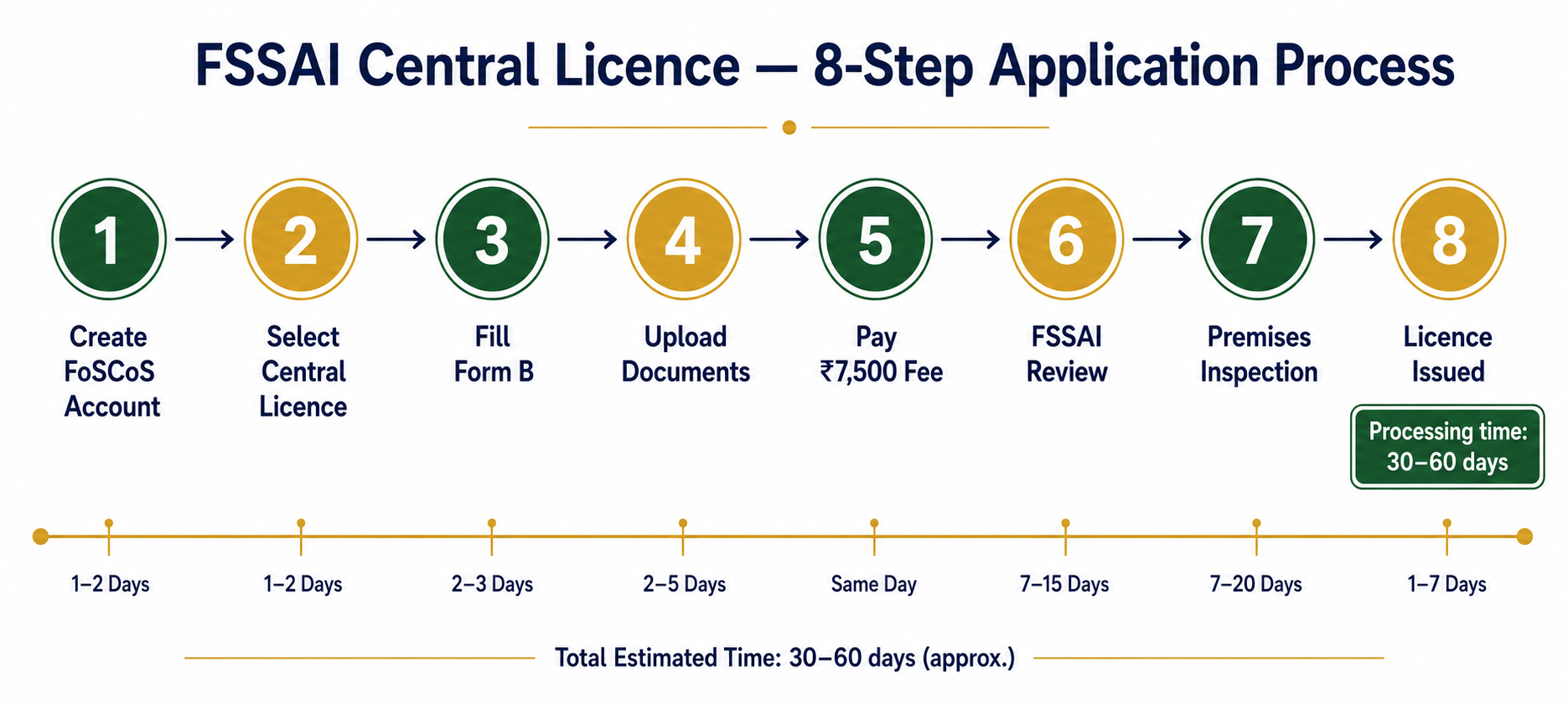
5. How to apply for FSSAI Central Licence — step by step
The application is filed online through the FoSCoS portal (Food Safety Compliance System) at foscos.fssai.gov.in. The process has been substantially digitized — physical visits to FSSAI offices are rarely required for standard applications.
Create FoSCoS account
Register on foscos.fssai.gov.in with business PAN, mobile number, and email. The system generates a login credential for the applicant.
Select licence type
Choose "Central Licence" and select the relevant food business category — for spice exporters, this is typically "Manufacturing / Processing" combined with "Export."
Fill Form B
Form B is the Central Licence application form. Key sections include: Business entity details, nature of food business, list of food products, installed capacity, premises details, and details of food safety management system.
Upload required documents
All documents submitted digitally via FoSCoS. See the complete documents list in Section 6.
Pay application fee
Fee for Central Licence: ₹7,500 per year. For a 5-year licence: ₹37,500 payable upfront. Payment via online banking through the FoSCoS portal.
Application review & Inspection
The designated officer reviews the application. They may request additional documents or schedule a premises inspection for manufacturing units to verify hygiene standards.
Licence issued
If satisfactory, the Central Licence is issued digitally. The 14-digit FSSAI licence number is the key credential used on all export documentation. Processing time: 30–60 days.
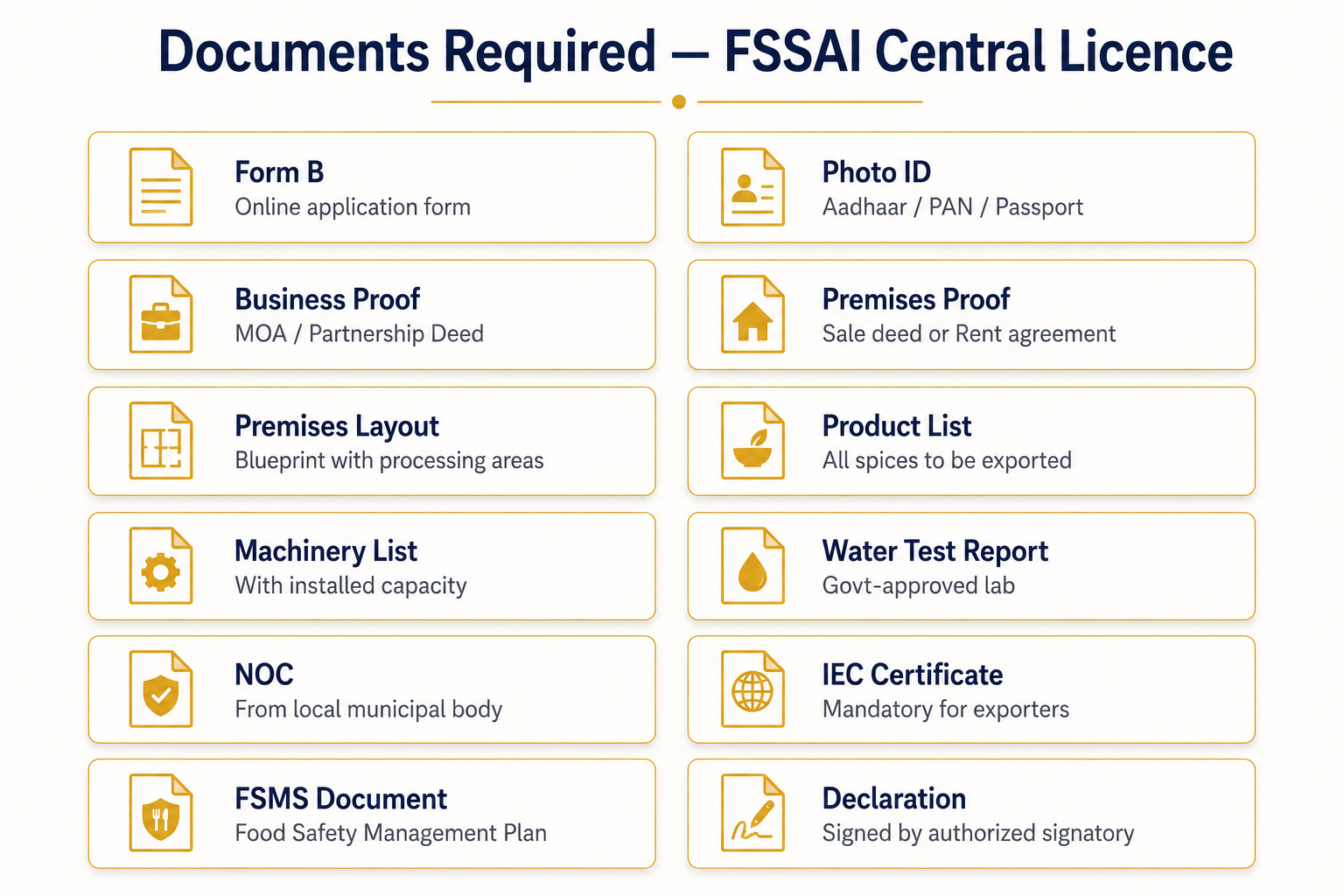
6. Documents required for FSSAI Central Licence application
| Document | Notes |
|---|---|
| Form B | Online form on FoSCoS portal |
| Photo ID | Aadhaar, PAN, or Passport of proprietor/director |
| Proof of business entity | Partnership deed / MOA / Certificate of Incorporation |
| Proof of premises | Owned: sale deed. Rented: rent agreement + NOC from landlord |
| Layout plan | Showing processing area, storage, washrooms, entry/exit |
| List of food products | All spices and spice products to be exported |
| Machinery list | With installed capacity |
| Water testing report | From government-approved lab — must show potable water parameters |
| IEC | Mandatory for exporters |
| FSMS document | Basic FSMS manual or HACCP plan |
7. FSSAI compliance obligations after registration
Obtaining the FSSAI Central Licence is the beginning — not the end — of compliance obligations. The licence carries ongoing requirements that exporters must meet to keep it valid.
- Annual return filing: Every FSSAI licence holder must file an Annual Return (Form D1) by 31st May each year, declaring the quantity of food products manufactured/handled in the previous financial year.
- Licence renewal: The Central Licence is valid for 1–5 years. Renewal must be applied for at least 30 days before expiry.
- Self-inspection: FSSAI requires food businesses to conduct periodic self-inspections of their premises against the FSSAI checklist and maintain records.
- Product recall procedure: Licence holders must have a documented product recall procedure in place.
- FSMS records: Cleaning schedules, pest control logs, water testing reports, and employee training records must be maintained.
- FSSAI audit / inspection: Food safety officers can conduct unannounced inspections of any licensed premises.
8. What is the Spice Board of India — overview and mandate
The Spice Board of India is a statutory body established under the Spices Board Act, 1986, functioning under the Ministry of Commerce and Industry. It is headquartered in Kochi, Kerala.
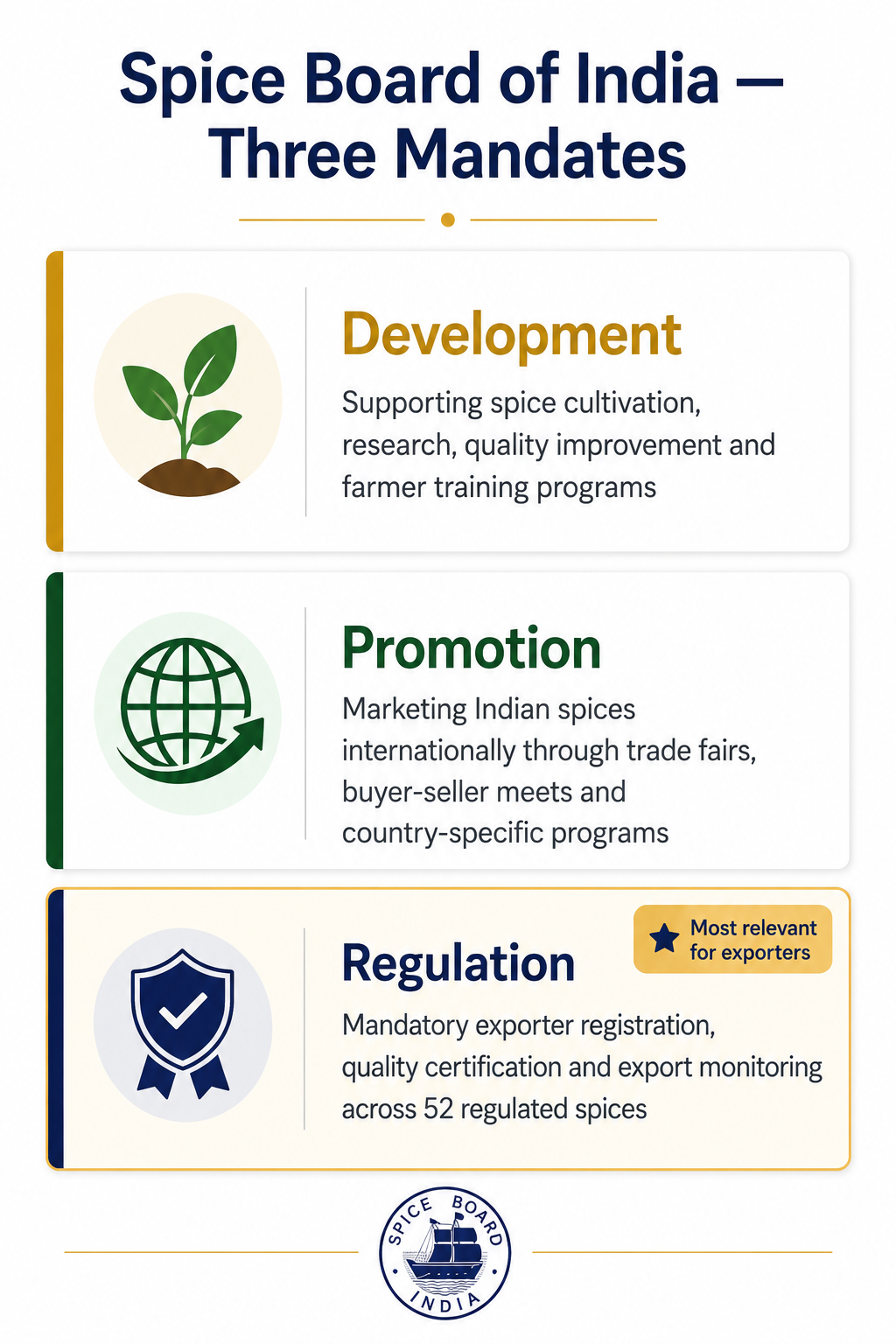
The Spice Board's dual mandate is:
- Development: Supporting spice cultivation, research, quality improvement, and the development of Indian spice farmers.
- Promotion: Marketing Indian spices internationally through participation in global trade fairs and buyer-seller meets.
- Regulation: Ensuring that Indian spice exports meet quality and food safety standards through mandatory exporter registration and quality certification.
Spices regulated by the Spice Board: The Spice Board has jurisdiction over 52 spices listed in the Schedule to the Spices Board Act. These include turmeric, ginger, cardamom, pepper, chilli, coriander, cumin, garlic, fennel, fenugreek, mustard, celery, dill, and all their derivatives.
9. Spice Board registration — who needs it
Every entity that exports spices from India commercially must be registered with the Spice Board of India. This is not discretionary. Section 8 of the Spices Board Act, 1986 prohibits the export of spices without a valid Spice Board registration.
- Spice manufacturers and processors who export their own product
- Trading houses and merchant exporters who buy and export spices
- Export management companies acting as agents for overseas buyers
- Companies exporting spice oleoresins, essential oils, or value-added spice products
- Organic spice exporters (additionally require APEDA registration)
10. How to apply for Spice Board registration — step by step
The application is filed online through the Spice Board's SPICES portal at spiceboard.gov.in. The process is straightforward for exporters who have their IEC and FSSAI licence already in place.
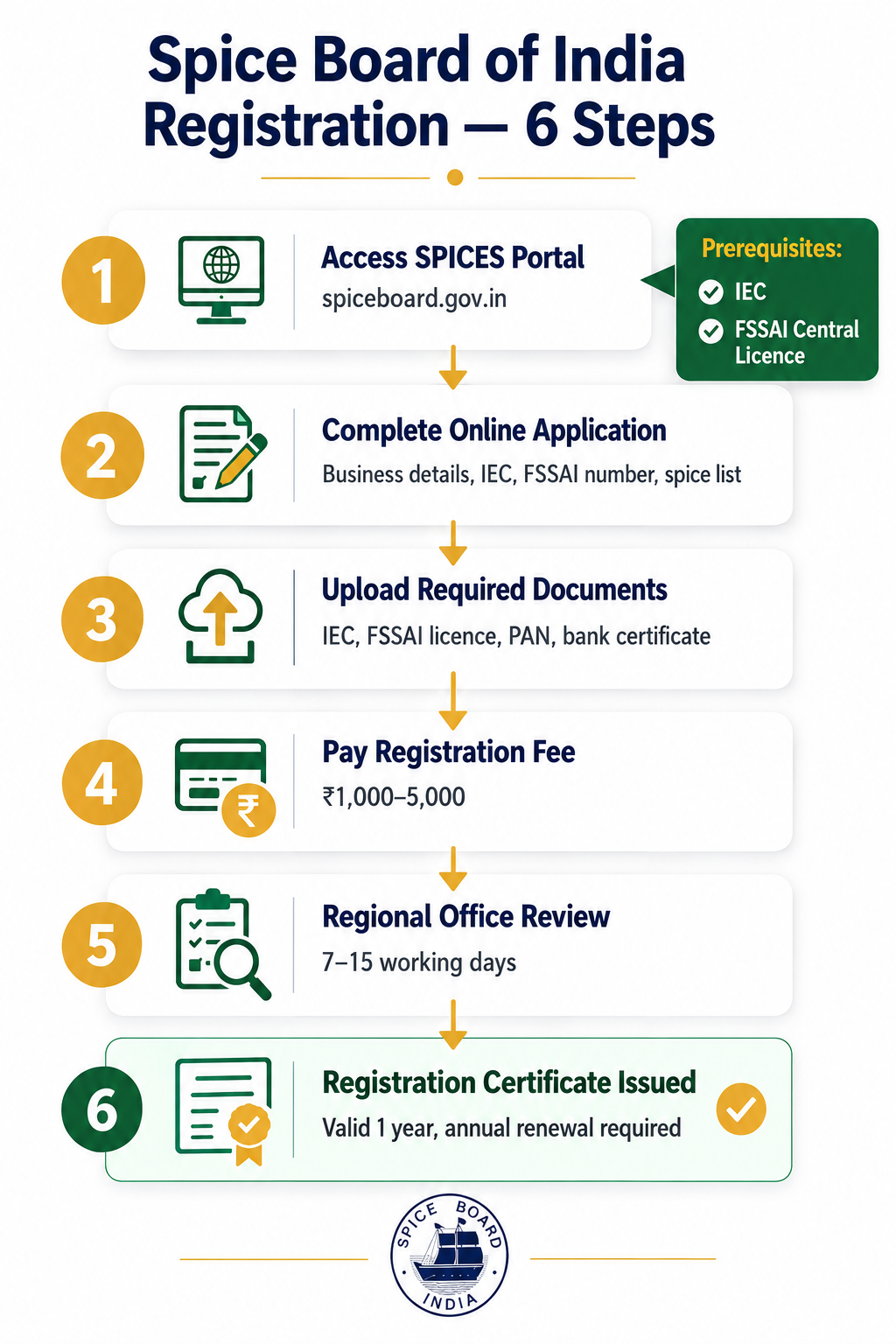
Step 1: Access the SPICES portal - Visit spiceboard.gov.in and navigate to the Exporter Registration section. Create a new account with business PAN and contact details.
Step 2: Fill the registration application - Include business details, IEC number, FSSAI licence number, list of spices, bank details, and facility info.
Step 3: Upload required documents - See the complete documents list in Section 11.
Step 4: Pay registration fee - Nominal fee of ₹1,000–5,000 depending on the category of registration.
Step 5: Application review - Approval is typically issued within 7–15 working days by the regional Spice Board office.
Step 6: Registration certificate issued - Issued digitally with registration number, authorized products, and validity period.
11. Documents required for Spice Board registration
- IEC certificate: Mandatory prerequisite
- FSSAI Central Licence: Mandatory prerequisite
- PAN card & Aadhaar: For business and identity verification
- Certificate of Incorporation / Partnership Deed: Proof of business entity
- GST Registration Certificate
- Bank certificate & Cancelled cheque: Confirming active export-purpose bank account
- Processing/packing facility proof: Ownership or lease document
- List of spices to be exported: From the Schedule of 52 spices
12. Spice Board compliance obligations after registration
- Annual renewal: Must be renewed every year on the SPICES portal.
- Export returns: Filing periodic export returns detailing quantities and destinations.
- Quality norms compliance: Maintaining product quality consistent with Spice Board standards.
- Per-shipment quality certificates: An inspector may draw samples for testing before issuing a per-shipment certificate.
13. What is IEC — Import Export Code explained
The Import Export Code (IEC) is a 10-digit identification number issued by the Directorate General of Foreign Trade (DGFT). It is the primary business identifier in all Indian export transactions. No Indian entity can export goods commercially without a valid IEC.
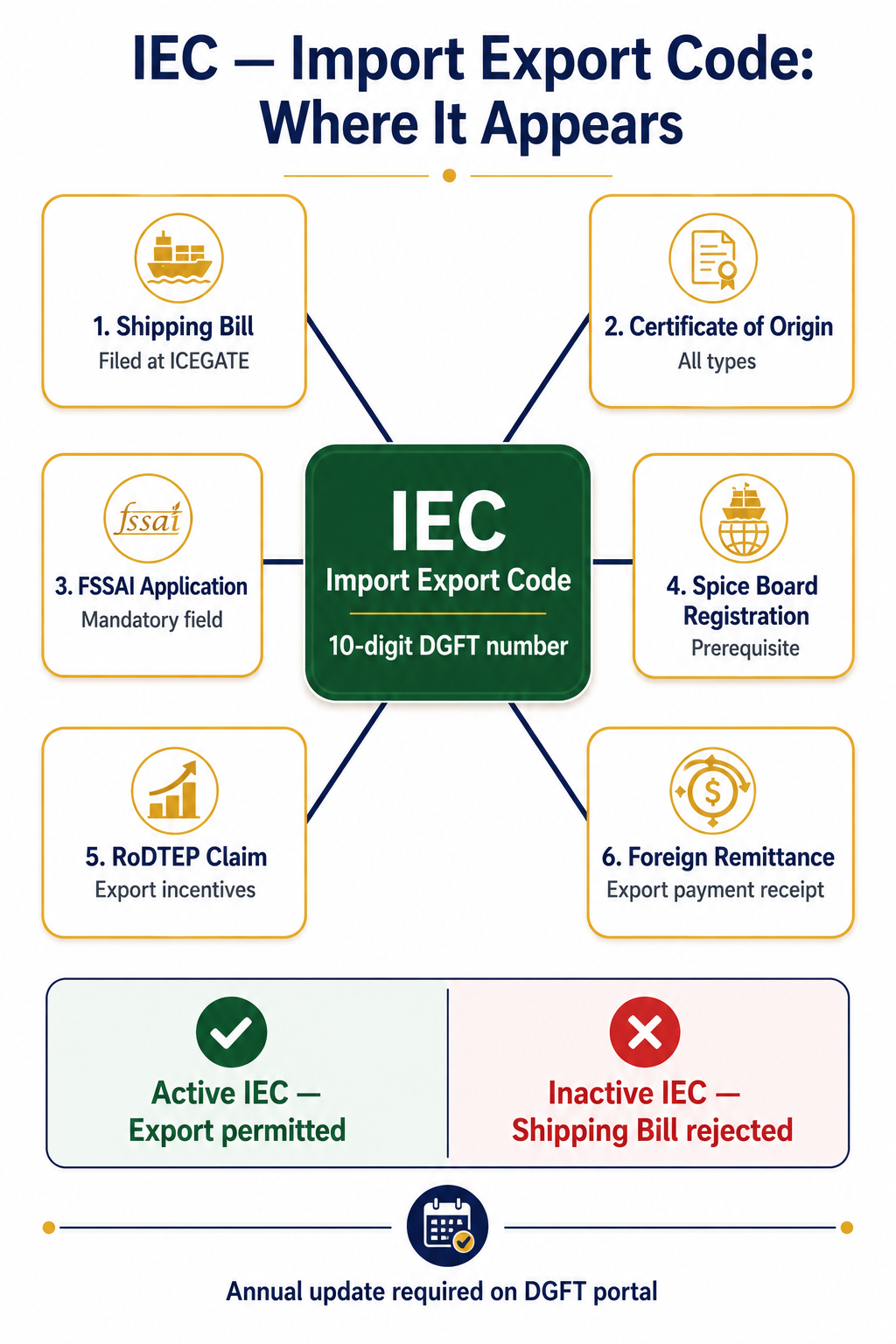
IEC is permanent — it does not expire. However, DGFT requires annual updation/confirmation of IEC details on the portal, even if no changes have occurred. Failure to update annually deactivates the IEC.
14. APEDA registration for organic spice exporters
For exporters supplying organic-certified spices, an additional registration is required: APEDA (Agricultural and Processed Food Products Export Development Authority) registration. APEDA administers India's National Programme for Organic Production (NPOP).
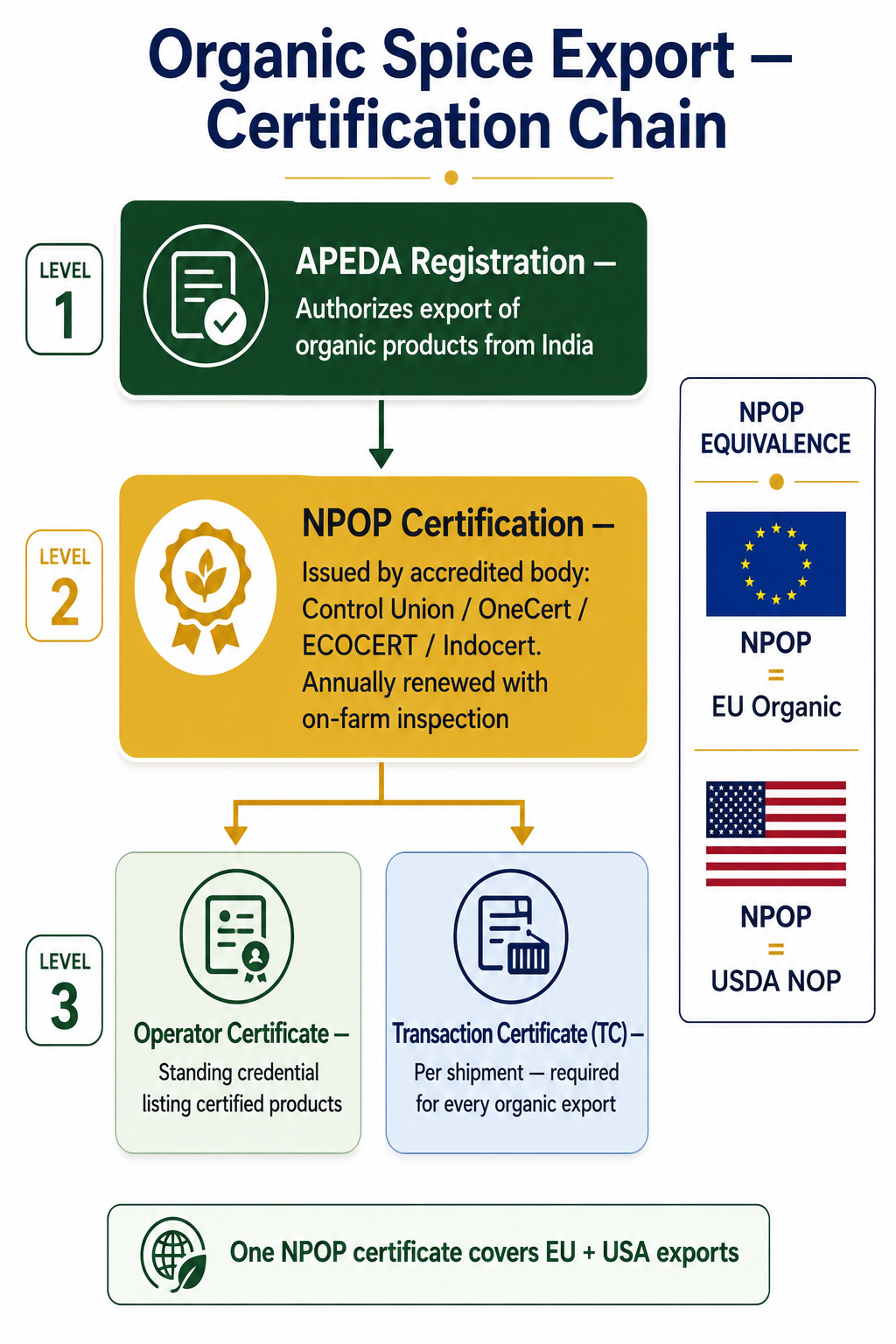
APEDA registration authorizes the exporter to trade organic products. However, the organic certification itself must be obtained from an APEDA-accredited certification body (e.g., Control Union, ECOCERT), which issues an Operator Certificate and a Transaction Certificate (TC) per shipment.
15. How importers can verify all four registrations online
Every registration listed in this guide is publicly verifiable online in under 5 minutes.
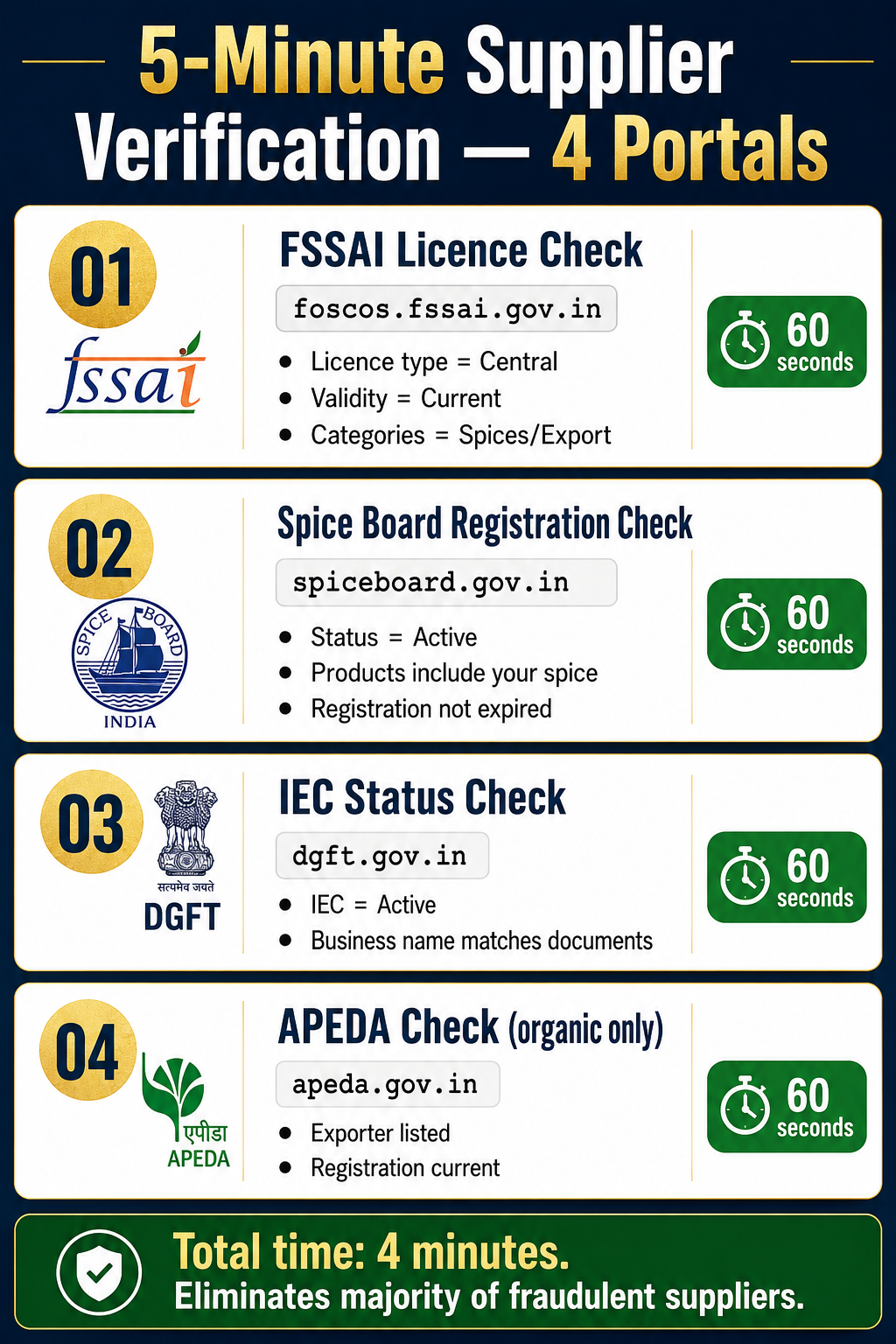
- FSSAI Central Licence: Visit foscos.fssai.gov.in → Licence/Registration Search.
- Spice Board Registration: Visit spiceboard.gov.in → Exporter Search / Registry.
- IEC Status: Visit dgft.gov.in → Services → IEC Search.
- APEDA (organic only): Visit apeda.gov.in → Exporter Login → APEDA Registered Exporters list.
16. Common registration mistakes and how to avoid them
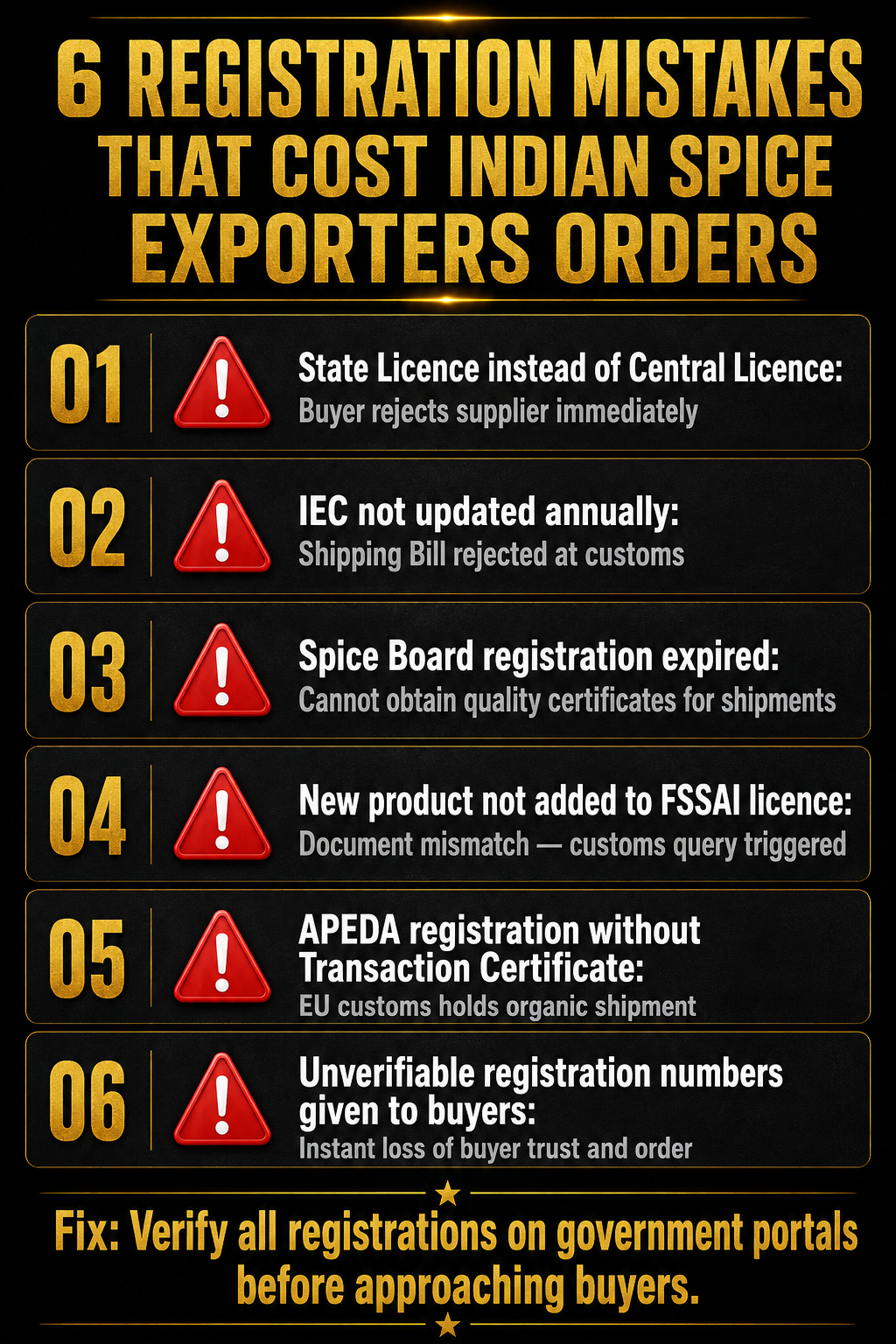
- Applying for a State Licence instead of a Central Licence (Central is mandatory for export).
- Forgetting the annual IEC update on the DGFT portal, rendering it inactive.
- Letting Spice Board registration expire during peak export season.
- Not listing all exported products on the FSSAI licence.
- Failing to obtain a Transaction Certificate (TC) per shipment for organic orders.
- Providing unverifiable or lapsed registration numbers to buyers.
17. How registrations connect to your export documentation
These registrations thread through every document in the export set:
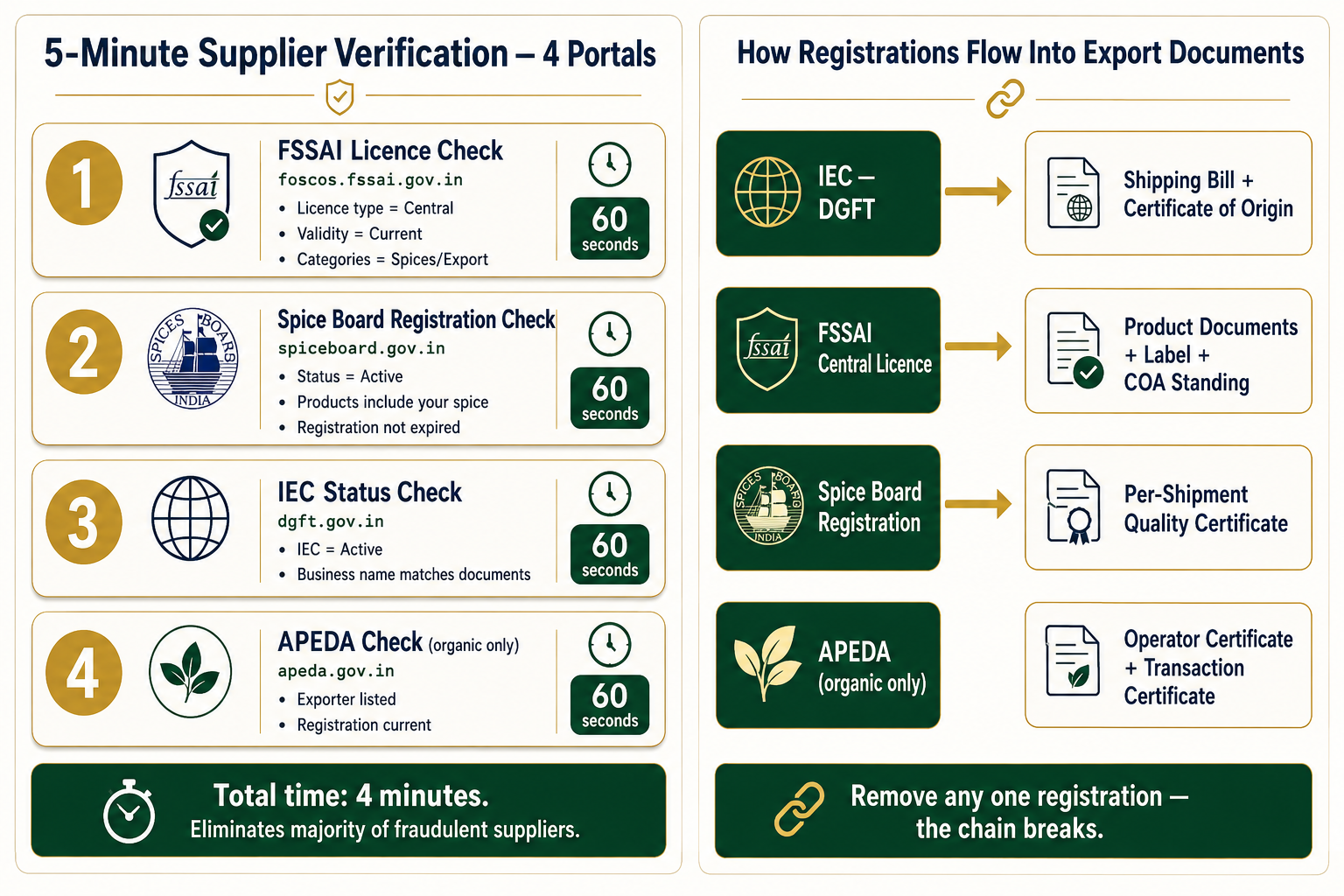
- IEC is required for filing the Shipping Bill at ICEGATE.
- FSSAI Central Licence number appears on product documentation.
- Spice Board registration enables obtaining per-shipment Spice Board quality certificates.
- COA from accredited labs reference the FSSAI-licensed facility.
See our spice export documentation guide and our turmeric powder export HS code and regulations guide for details on how certifications are evaluated.
18. Key takeaways
- FSSAI Central Licence and Spice Board registration are mandatory prerequisites for legal spice export.
- Export activity mandates a Central Licence regardless of turnover.
- IEC is the prerequisite for both FSSAI and Spice Board registrations.
- Organic exporters require APEDA registration and a TC per shipment.
- All four registrations are publicly verifiable online.
19. FAQs
Can a small exporter with low turnover operate on a State FSSAI Licence for export?
No. Export activity is explicitly categorized under the Central Licence requirement.
How long does it take to get both FSSAI and Spice Board registration?
FSSAI takes 30–60 days. Spice Board registration takes 7–21 days. Together, typically 45–60 days.
Can I export spices while my FSSAI application is pending?
No. Doing so is a violation of the Food Safety and Standards Act, 2006.
20. Conclusion
FSSAI Central Licence and Spice Board registration are not bureaucratic formalities. They are the legal foundation of every legitimate Indian spice export operation.
Sourcing spices from a fully registered, compliant Indian exporter?
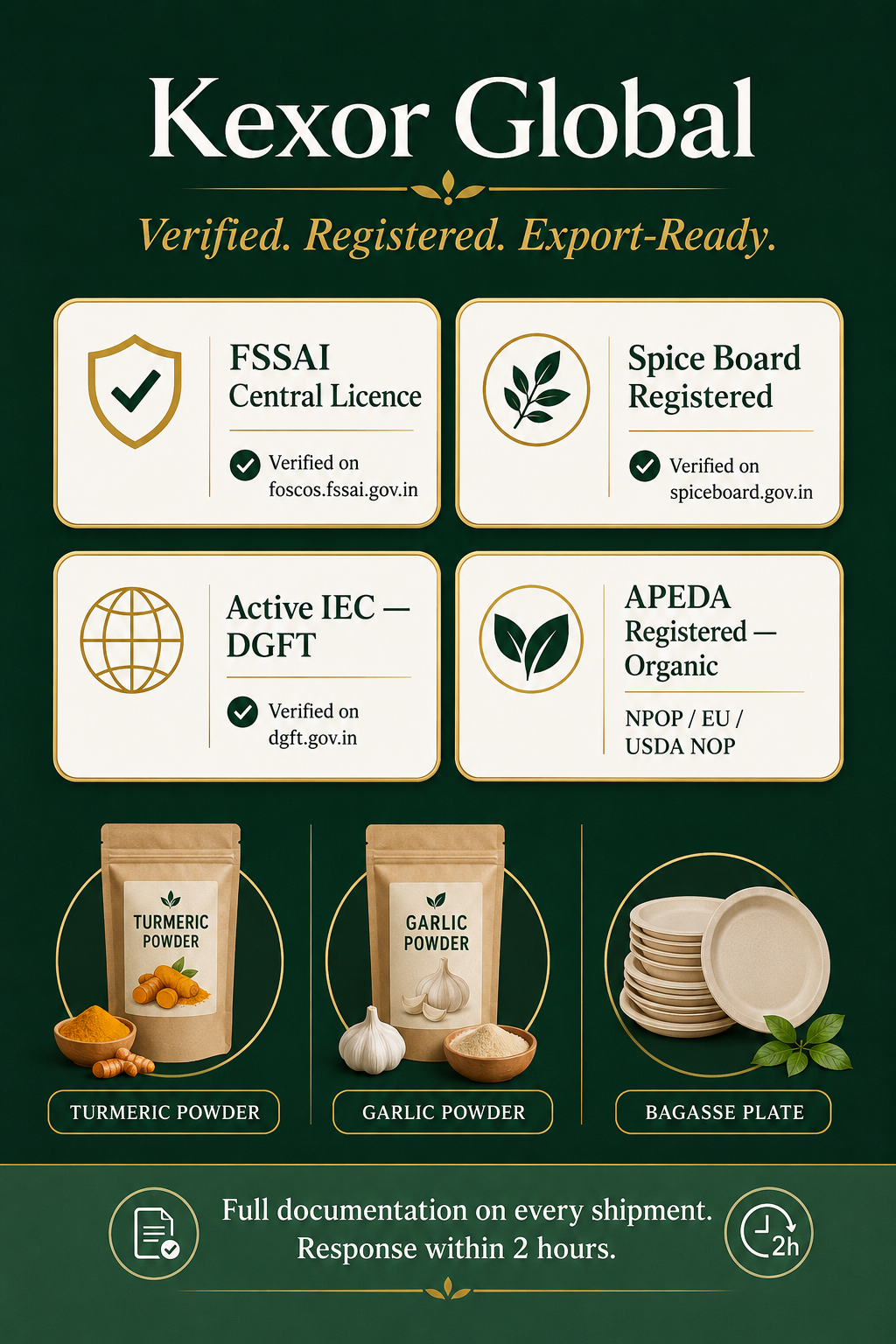
Kexor Global holds all mandatory export registrations — FSSAI Central Licence, Spice Board of India registration, IEC, and APEDA registration for organic products. Every registration is current and publicly verifiable.
- Turmeric powder, garlic powder, dehydrated onion, red chilli powder
- Conventional and organic certified (NPOP / NOP / EU Organic equivalent)
- Eco-friendly bagasse packaging
- Full export documentation as standard
- Response within 2 hours